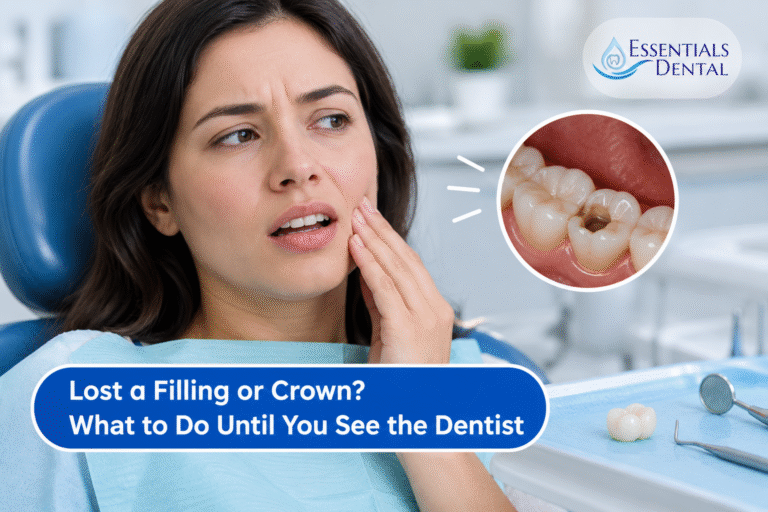

Your teeth are tough, but they are not invincible. Over time, decay, damage, and daily wear can weaken a tooth to the point where a simple filling is no longer enough. That is when a dental crown becomes necessary. The tricky part? Many people do not realize they need a crown until the problem has gotten much worse. Some warning signs are easy to ignore, especially when there is no pain at first. But waiting too long can turn a straightforward crown into a much bigger and more expensive dental problem.
In this blog, we will walk you through the 6 most important signs you need a dental crown, explain what happens to your tooth if you put it off, and cover some of the most common questions people have about leaking crowns, crown failure, and when a crown should be replaced.
Quick Answer: When Is a Crown Needed?
A crown is needed when a tooth is too damaged, cracked, decayed, or weakened for a filling to fix it properly. Signs include sharp pain when biting, a visible crack, a large or failing filling, sensitivity that will not go away, a tooth that has had a root canal, or a crown that is already leaking or broken.
The 6 Signs You Need a Dental Crown
Sign 1: You Have a Cracked or Fractured Tooth
A cracked tooth is one of the most common reasons people need a crown. Cracks can happen from biting on something hard, an old injury, or even from grinding your teeth at night. The problem with cracks is that they can be hard to see, and they do not always hurt right away.
You might notice:
- A sharp pain when you bite down or release pressure on the tooth
- Pain that comes and goes but never fully goes away
- Sensitivity to hot or cold that lingers after the temperature source is gone
- A thin line on your tooth that you can sometimes feel with your tongue
If you leave a cracked tooth untreated, the crack can spread deeper into the root. Once the crack reaches the root, the tooth may no longer be saveable with a crown alone. You could end up needing an extraction instead. A crown placed early holds the tooth together, stops the crack from spreading, and protects the nerve inside.
Sign 2: You Have a Large Cavity or Tooth Decay That Cannot Be Filled
Fillings are great for small to medium cavities, but every filling has a size limit. When decay has destroyed too much of the tooth structure, a filling simply does not have enough healthy tooth to hold onto. Placing a large filling in a heavily decayed tooth is like patching a hole in a wall that is already about to fall.
Your dentist may recommend a crown instead of a filling when:
- More than half of the tooth surface has been affected by decay
- A filling would be too large to stay stable long-term
- The remaining tooth walls are too thin to support a filling without breaking
Skipping the crown and leaving severe decay untreated puts you at serious risk. Decay can travel through the tooth into the pulp (the soft tissue inside the tooth), causing a painful infection. At that point, a root canal may become necessary before any crown can even be placed. Catching it early means a simpler, less expensive treatment. Our team at Essentials Dental can assess whether your tooth needs a filling or a crown during a routine checkup.
Sign 3: You Have a Large or Failing Old Filling
Old fillings do not last forever. Over years of chewing and temperature changes, fillings can crack, shrink slightly, or pull away from the tooth. When a filling starts to fail, gaps can form between the filling and the tooth. These gaps allow bacteria to sneak in and cause new decay underneath the filling, which is called secondary decay.
Signs that your filling may be failing include:
- Pain or pressure around a tooth that already has a filling
- A filling that feels rough, uneven, or different when you run your tongue over it
- Sensitivity in a tooth that had no sensitivity before
- A visible dark area or discoloration around an old filling
When a filling reaches a certain size or when the tooth around it has been weakened by repeated drilling and repair, the dentist will recommend a crown instead. A crown fully encases the tooth, providing full protection that a filling cannot.
Want to learn more about your crown options? Visit our Dental Crown Services page to see what treatments are available at Essentials Dental.
Sign 4: You Have Severe Tooth Sensitivity That Does Not Go Away
Some tooth sensitivity is completely normal, especially to hot or cold foods. But if you have intense sensitivity that lasts more than a few seconds, or that happens on its own without any trigger, that is a warning sign that something deeper is going on.
Persistent sensitivity can mean:
- The enamel on your tooth has worn down so much that the inner layer (called dentin) is exposed
- A crack in the tooth is allowing temperature and pressure to reach the nerve
- Decay has gotten close to or into the pulp of the tooth
When sensitivity is caused by significant structural damage, a crown can cover and insulate the tooth, blocking those pain signals. If you ignore this sign, the nerve can become inflamed or infected, which moves you from needing a crown to needing a root canal followed by a crown. That is a longer process, more visits, and a higher cost.
Sign 5: You Have Had a Root Canal
After a root canal, the tooth is essentially hollow. The infected pulp has been removed, and the canal has been cleaned and sealed. This is a very effective treatment, but it leaves the tooth significantly weaker and more brittle than it was before.
Without a crown to protect it, a tooth that has had a root canal is at high risk of:
- Cracking or fracturing under normal chewing pressure
- Breaking off at the gum line
- Becoming reinfected if the seal at the top of the tooth is compromised
This is why dentists almost always recommend placing a crown after a root canal, especially on back teeth that take a lot of biting force. Skipping the crown after a root canal is one of the most common reasons teeth that were saved by root canals end up being extracted a few years later.
Curious about what the full crown process looks like? Read our detailed guide: Dental Crown Treatment: A Step-by-Step Guide.
Sign 6: Your Existing Crown Is Leaking, Cracked, or Worn Out
A dental crown does not last forever. Most crowns last between 10 and 15 years, and sometimes longer, with great care. But over time, they can develop problems that require attention.
Leaking crown symptoms are something many people do not know to look for. A leaking crown means the seal between the crown and the tooth has broken down, allowing saliva and bacteria to seep underneath. This is a serious problem because once bacteria get under the crown, they can cause decay on the natural tooth underneath, which is called recurrent decay.
Common leaking crown symptoms and signs of crown failure include:
- Pain or sensitivity in a tooth that already has a crown, especially to sweets or temperature changes
- A bad taste or smell coming from around the crown
- The crown feels loose or rocks slightly when you bite
- You can see a dark line or discoloration at the edge of the crown near the gum
- The crown has chipped or cracked visibly
- Your gum around the crown is swollen, red, or bleeds easily
If you notice any of these leaking crown symptoms, do not wait. Once decay forms under a crown, it can progress quickly because the bacteria are sealed in a warm, dark environment. The longer you wait, the more tooth structure is lost, and there may not be enough tooth left to support a new crown.
How Often Should a Crown Be Replaced?
This is one of the most common questions patients ask. The honest answer is: it depends. There is no set schedule for replacing a crown, the way you replace a car tire. Crowns are replaced when they need to be, not on a fixed timeline.
That said, here are some general guidelines:
- Porcelain crowns typically last 10 to 15 years with good care
- Zirconia and metal crowns can last 15 to 20 years or even longer
- Crowns need to be replaced sooner if they chip, crack, develop a leak, or if decay forms underneath them
- People who grind their teeth (bruxism) may need replacements sooner because grinding puts extra force on the crown
Your dentist will check your crowns at every routine checkup using X-rays and visual examination. This is one of the main reasons regular dental visits matter. A problem caught early means a simpler fix. To see the technology we use to check crowns precisely, visit our Advanced Technology page.
What Happens If You Ignore the Signs?
This is the part most people wish they had read earlier. Waiting to get a crown when your tooth is showing warning signs almost always leads to a worse outcome. Here is a realistic look at what can happen:
The Crack Gets Worse
A small crack that could have been stabilized with a crown can spread to the root of the tooth. Once the root is cracked, the tooth usually cannot be saved. You go from needing a crown to needing an extraction and a dental implant or bridge, which is far more involved and expensive.
Decay Reaches the Nerve
When a cavity or failing filling is left too long, bacteria work their way deeper into the tooth. When they reach the pulp, you develop an abscess, which is a painful infection. Now you need a root canal before the crown can go on. The treatment cost goes up, the recovery takes longer, and the tooth has been through more trauma.
You Lose the Tooth Entirely
In the worst cases, waiting too long means the tooth cannot be saved at all. An extraction leaves a gap in your mouth, which over time can cause the surrounding teeth to shift, affect your bite, and lead to bone loss in the jaw. Replacing a missing tooth with an implant is a much bigger commitment than getting a crown when the tooth first needed one.
Leaking Crown Damage Compounds
If you already have a crown and you are experiencing leaking crown symptoms, the decay under the crown is getting worse every day you wait. Once the decay is deep enough, the post used to anchor the crown may not have enough tooth structure to hold. At that point, even placing a new crown becomes difficult or impossible.
The bottom line is simple: the earlier you act on the signs you need a dental crown, the easier, faster, and more affordable the treatment will be. If you are seeing any of these signs and want to know where you stand, our team is ready to help. Contact us today to schedule an evaluation.
When Would You Need a Dental Crown Versus a Different Treatment?
Not every damaged tooth needs a crown. Here is a simple way to think about it:
- Small to medium cavity with enough healthy tooth: A filling is usually enough
- Large cavity, crack, or weakened tooth: A crown is the better choice
- Severely damaged tooth with deep root issues: You may need a root canal first, then a crown
- Tooth that cannot be saved: Extraction followed by an implant or bridge
Only your dentist can tell you which treatment is right for your specific tooth. The signs we covered in this blog are a guide to help you know when it is time to pick up the phone and make an appointment. Our experienced team at Essentials Dental takes the time to explain all your options clearly, so you can make the decision that is right for you. Meet our team here.
Frequently Asked Questions
What are the most common signs you need a dental crown?
The most common signs include a cracked or broken tooth, a large cavity that is too big for a filling, an old or failing filling, tooth sensitivity that does not go away, a tooth that has had a root canal, and an existing crown that is leaking, chipped, or loose. If you have any of these issues, see your dentist as soon as possible.
What are the symptoms of a leaking crown?
Leaking crown symptoms include pain or sensitivity in a tooth that already has a crown, a bad taste or smell near the crown, the crown feeling loose, dark discoloration at the edge of the crown near the gum line, and swollen or bleeding gums around the crown. If the crown is leaking, bacteria and decay can form underneath it and damage the natural tooth below.
Can a tooth that needs a crown wait?
In some cases, your dentist may say it is safe to monitor for a short time. But if a tooth is cracked, heavily decayed, or showing signs of infection, waiting makes the problem worse. Most of the time, acting sooner leads to a simpler and less expensive treatment. Waiting often means the damage progresses to the point where a crown alone is no longer enough.
How do I know if my crown has failed?
Signs of crown failure include pain when biting, sensitivity to hot, cold, or sweets, a visible crack or chip in the crown, the crown feeling loose or moving, a dark line at the gum, and a persistent bad taste or odor. Any of these signs warrants a visit to your dentist so they can take X-rays and examine what is happening under and around the crown.
How often should a crown be replaced?
There is no set replacement schedule. Most crowns last 10 to 15 years, with some lasting 20 years or more, depending on the material and how well you care for them. Your dentist checks your crowns at each visit. A crown should be replaced when it is damaged, leaking, cracked, or when decay has formed underneath it, not simply based on age alone.
What happens if you leave a tooth that needs a crown untreated?
Ignoring a tooth that needs a crown can lead to the crack spreading to the root, decay reaching the nerve and causing an abscess, the need for a root canal, or the tooth becoming so damaged that it has to be extracted. What starts as a relatively straightforward crown placement can escalate into a much more complex and costly treatment if ignored.
Is crown placement painful?
The procedure itself is done under local anesthesia and should not be painful. You may feel some pressure during tooth preparation, but not pain. Some mild sensitivity or soreness around the gum after the appointment is normal and usually fades within a couple of days.
Conclusion
Knowing the signs you need a dental crown is the first step toward protecting your smile and avoiding more serious dental problems down the road. From a cracked tooth or a large cavity to a failing old crown with leaking crown symptoms, catching the warning signs early makes treatment simpler, faster, and more affordable.
The six signs covered in this blog are not something to put off. Teeth do not heal on their own, and waiting almost always means the problem gets worse. Whether you are dealing with a tooth that needs a crown for the first time or an existing crown that may be failing, the sooner you act, the better the outcome.
If you think you might need a crown or you have noticed any of the signs we described, the best next step is a simple dental evaluation. Book your appointment today and let our team at Essentials Dental give your tooth the attention it deserves.