

Professional teeth whitening is a dentist-supervised treatment that uses peroxide-based gel to lighten natural enamel, often by several shades in one visit.
If you’ve been comparing whitening strips, drugstore kits, and an actual dental appointment, you’re not alone. It’s one of the most common questions patients bring up at a checkup. Here’s what professional whitening actually involves at Essentials Dental, what teeth whitening results to realistically expect, and what to know before you book your first treatment.
In this article:
- What Is Professional Teeth Whitening?
- In-Office vs. At-Home Whitening
- What Happens During an Appointment
- How Many Shades Whiter Will You Get?
- Is It Safe?
- Does It Work on Crowns or Veneers?
- How Long Do Results Last?
- How to Prepare for Your First Treatment
- FAQ
Quick Answer: Professional Teeth Whitening at Glendale Heights
What it is: Dentist-supervised bleaching using peroxide gel, stronger than over-the-counter products.
Results: Most patients see 4 to 8 shades of whitening after one in-office session.
Time: In-office sessions typically run 45 to 90 minutes; take-home trays work over 1 to 2 weeks.
Safety: Considered safe for most adults; temporary sensitivity is the most common side effect.
Restorations: Will not change the color of crowns, veneers, or fillings.
Longevity: Results generally last 6 months to a year, depending on diet and habits.
Cost: Typically a few hundred dollars per in-office visit, varying by system and location.
What Is Professional Teeth Whitening?
Professional teeth whitening, sometimes called cosmetic teeth whitening, professional whitening services, or teeth bleaching treatment, is performed or supervised by a dentist using a peroxide-based gel. The two most common active ingredients are hydrogen peroxide and carbamide peroxide.
According to the American Dental Association’s clinical guidance on whitening, both compounds readily penetrate the dense tissue of the tooth, which is how they break down the stain molecules trapped inside enamel. This is the same basic chemistry used in over-the-counter products, just at a higher, dentist-controlled concentration with closer supervision.
That distinction matters. A drugstore strip uses a low percentage of peroxide because it has to be safe for unsupervised use. A dentist can use a stronger formula precisely because they’re monitoring your gums, your enamel, and your sensitivity in real time. To learn more about our full range of smile-enhancing treatments, visit our cosmetic dentistry page.
In-Office vs. At-Home Professional Whitening: What’s the Difference?
Both options are professional, dentist-supervised treatments. They differ mainly in speed, concentration, and how the gel is delivered.
| In-office whitening | At-home professional trays | |
| Where it happens | Dental chair, single visit | Custom trays you use at home |
| Time to results | Often, a single appointment | Days to a couple of weeks |
| Peroxide concentration | Higher | Lower, used for a longer contact time |
| Activation | Often, LED or light-activated | No activation light needed |
| Best for | Patients who want fast, visible results | Patients who prefer gradual change or have sensitivity concerns |
Many dentists also combine the two: an in-office visit for a quick initial result, followed by take-home trays to maintain it.
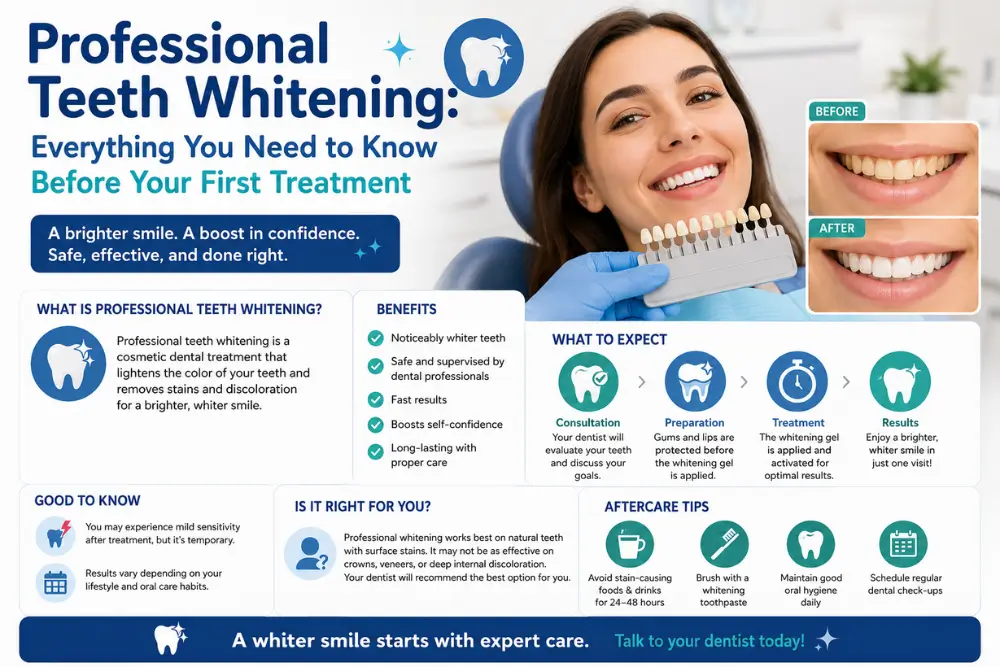
What Happens During an In-Office Whitening Appointment
In-office, the best teeth whitening treatment generally follows five steps:
- Shade assessment. Your dentist checks your current tooth color against a shade guide so you can both see the starting point and track progress.
- Gum and lip protection. A protective barrier or gel is applied to your gums and the soft tissue around your lips, since the bleaching gel is too strong for unprotected skin.
- Gel application. A peroxide-based whitening gel is applied directly to the front surface of your teeth.
- Activation. Many in-office systems use an LED or specialized light part of the advanced technology used in modern dental offices, to accelerate the bleaching reaction. The gel is typically reapplied in cycles over the appointment.
- Final shade check. Once the gel is removed and your teeth are rinsed, your dentist compares your new shade against the original.
Most in-office sessions typically last between 45 and 90 minutes.
How Many Shades Whiter Will You Get?
Most patients see their teeth whitening results lighten by four to eight shades after a single professional in-office whitening session, though the outcome depends heavily on your starting shade and the type of staining you have. Cleveland Clinic’s own patient guidance puts the range similarly, noting that light-activated, in-office whitening can lighten teeth three to eight shades, far beyond what a whitening toothpaste can achieve on its own.
Surface stains from coffee, tea, red wine, or tobacco tend to respond the fastest and most dramatically. Teeth that are naturally more yellow-toned also tend to lighten more easily than teeth with a gray or brown cast, which can be more resistant to bleaching.
One practical note: right after treatment, your teeth often look even whiter than they’ll end up looking once you’ve had a glass of water. Part of the immediate effect is mild dehydration of the enamel, and the true, settled shade usually shows up within a couple of days.
Is Professional Teeth Whitening Safe?
Yes, professional teeth whitening is considered safe for most adults when supervised by a dentist. The most common side effects are temporary tooth sensitivity and mild gum irritation, both of which are typically short-lived.
This lines up with the broader research on the subject. A 2018 Cochrane review cited by the ADA found that tooth sensitivity and oral irritation were the most frequently reported side effects of home-based whitening and that these effects were mild and temporary even at higher peroxide concentrations.
Who Isn’t a Great Candidate for Whitening
A dentist may recommend against whitening or suggest a modified approach if you have the following:
- Existing gum disease or active cavities. These should be treated first.
- Significant tooth or gum sensitivity. A lower-concentration take-home option is often used instead.
- Deep, intrinsic staining. Some discoloration, particularly from certain medications or dental trauma, doesn’t respond well to bleaching and may need a different cosmetic approach.
- Pregnancy. Many dentists prefer to postpone elective cosmetic whitening until after pregnancy, simply out of caution rather than documented harm.
If any of these apply to you, that’s not necessarily a dead end. It usually just means your dentist will recommend a different timeline or method. Our team can walk you through the right approach for your situation.
Does Teeth Whitening Work on Crowns, Veneers, or Fillings?
No. Professional teeth whitening only changes the color of natural tooth enamel. It does not lighten crowns, veneers, or tooth-colored fillings, regardless of which whitening method you use.
The reason comes down to material science rather than the whitening product itself. Natural enamel is porous, which is precisely why it absorbs stains in the first place and why a bleaching gel can get inside it to break them down.
Porcelain, ceramic, and composite resin restorations are manufactured to be non-porous and stain-resistant, which is a feature for durability, but it also means whitening gel has nothing to penetrate.
In practice, this matters most if you have a visible restoration on a front tooth. Whitening the teeth around it will make the natural teeth lighter while the restoration stays exactly the shade it was made in, which can create a noticeable mismatch. Many dentists recommend whitening first, letting the new shade settle for a week or two, and then matching any new crown or veneer to that final color.
How Long Do Professional Whitening Results Last?
Professional in-office whitening results typically last between six months and one year before noticeable re-staining occurs, though the duration varies a lot based on your diet and habits.
Coffee, tea, red wine, dark sauces, and tobacco are the biggest culprits behind teeth re-staining after a whitening treatment. Patients who cut back on these or rinse with water shortly after consuming them tend to keep their results longer.
Many dentists also provide a lower-concentration take-home gel for occasional touch-ups, which can stretch results out considerably longer than a single in-office visit alone.
How to Prepare for Your First Professional Whitening Treatment
A little preparation can significantly contribute to a smooth first appointment.
- Get a checkup first. Untreated cavities or gum disease need to be addressed before whitening, both for your comfort and for the treatment to work properly.
- Mention any restorations. Please inform your dentist about any existing crowns, veneers, or visible fillings so they can plan for the shade-matching issue in advance.
- Flag sensitivity concerns early. If you already have sensitive teeth, say so. Your dentist can adjust the concentration or add a desensitizing step.
- Avoid staining foods and drinks right before your visit. While this won’t directly impact the treatment, it’s a beneficial practice to adopt.
- Plan for a short sensitivity window afterward. Many patients are advised to avoid very hot, cold, or staining foods and drinks for 24 to 48 hours post-treatment while the enamel settles.
The Bottom Line
Professional teeth whitening is one of the safest, most predictable ways to brighten a smile when it’s done under a dentist’s supervision. The science behind it is straightforward: a stronger, monitored version of the same peroxide chemistry used in store-bought products, applied with the benefit of a professional shade assessment and ongoing care.
If you’re considering treatment, the best first step is a conversation with your dentist about your goals, your starting shade, and whether you have any restorations to plan around. Contact us with any questions, or book your teeth whitening consultation with Essentials Dental at our Glendale Heights or Lombard location to find out which whitening option fits your smile.
Frequently Asked Questions
Is teeth whitening the same as teeth bleaching?
Mostly yes. “Bleaching” technically refers to treatments that use peroxide to change the tooth’s natural color, while “whitening” is sometimes used more broadly to include surface cleaning. In everyday use, dentists and patients use the terms interchangeably for professional treatment.
How much does professional teeth whitening cost?
Cost varies by treatment type, the system used, and your location, generally ranging from a few hundred dollars for a single in-office visit to higher amounts for combined in-office and take-home programs. Your dentist can give you an exact quote once they’ve assessed your teeth and discussed your goals.
Is in-office or at-home professional whitening better?
Neither is universally better. In-office whitening is faster and gives a bigger initial change in one visit, while at-home professional trays work more gradually with less risk of sensitivity. Many patients use both: an in-office visit followed by trays for maintenance.
Does professional teeth whitening hurt?
It shouldn’t hurt during the procedure itself. Some patients experience temporary tooth sensitivity or mild gum irritation in the hours or days afterward, which is usually managed with toothpaste designed for sensitive teeth and typically resolves within a few days.
How soon can I eat or drink after whitening?
Most dentists recommend sticking to a “white diet,” avoiding dark or staining foods and drinks like coffee, red wine, and tomato sauce, for the first 24 to 48 hours after treatment while your enamel is most porous and prone to picking up new stains.
How often can I safely whiten my teeth?
This depends on the method and your enamel’s response, but many dentists recommend spacing professional in-office treatments several months apart, with occasional take-home touch-ups in between. Whitening more frequently than your dentist recommends raises the risk of sensitivity without meaningfully better results.


