

Losing teeth, whether to decay, gum disease, or an accident, changes more than your smile. It affects how you chew, how you speak, and how confident you feel every time you meet someone new. The good news is that modern dentistry offers reliable, natural-looking ways to replace missing teeth, and for many people the conversation starts with two options: full dentures and partial dentures.
Choosing between them isn’t always obvious. The right answer depends on how many teeth you’re missing, the health of the teeth you still have, your budget, and your day-to-day lifestyle. At Essentials Dental, we help patients weigh these factors every day so they can make a confident, informed choice. This guide breaks down how full dentures and partial dentures differ, who each one suits best, and how to decide which is right for you.
What Are Dentures and Partials?
Before comparing them, it helps to understand what dentures and partials are at a basic level, because the terms are often used loosely.
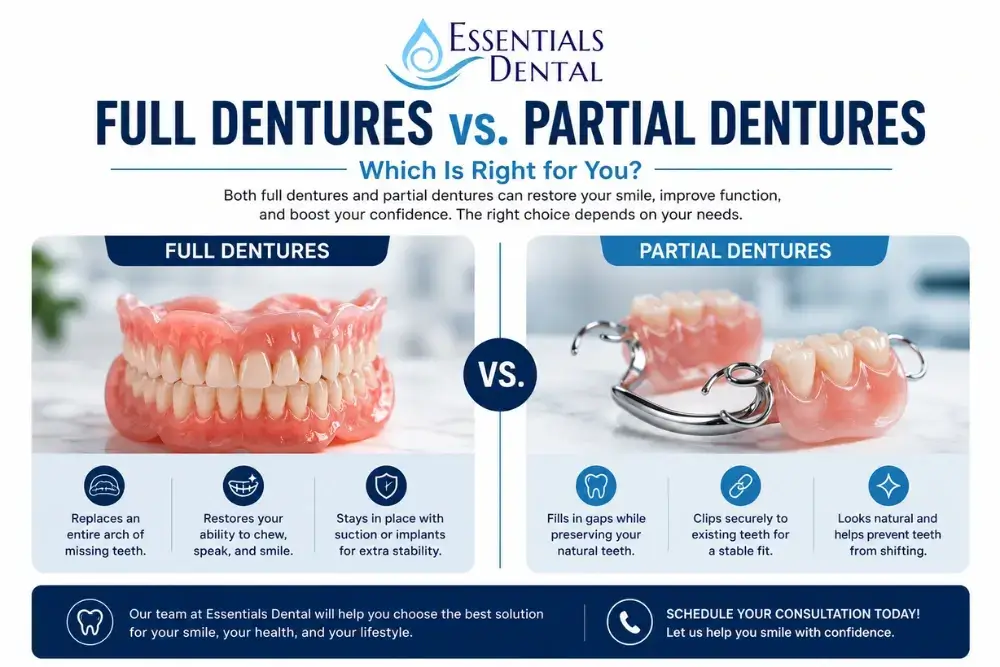
A denture is a removable appliance that replaces missing teeth and the surrounding tissue. A full denture (sometimes called a complete denture) replaces an entire arch of teeth, either the upper, the lower, or both. It rests directly on the gums and is used when all of the natural teeth in that arch are gone.
A partial denture replaces only some missing teeth while your remaining natural teeth stay in place. It typically features replacement teeth attached to a gum-colored base, held securely by small clasps or precision attachments that anchor to the teeth around the gap.
In short, full dentures replace everything, while partials fill in the blanks. Both are removable, both restore function and appearance, and both have come a long way in comfort and realism.
Full Dentures Explained
Full dentures are the solution when an entire arch of teeth is missing or needs to be removed. They’re custom-made to fit the unique contours of your mouth, and the replacement teeth are shaped and shaded to look natural.
A conventional full denture is placed after the gums have healed from any extractions, which usually takes several weeks. An immediate denture, by contrast, is inserted the same day teeth are removed so you’re never without a smile, though it may need adjusting as your gums settle.
Full dentures stay in place through a combination of suction, the natural contours of your gums, and sometimes a denture adhesive. For patients who want extra stability, implant-supported full dentures anchor to a few strategically placed dental implants, dramatically reducing slipping and improving chewing power.
Partial Dentures Explained
Partial dentures shine when you still have several healthy natural teeth. Rather than removing those teeth to make room for a full denture, a partial works around them, preserving what’s healthy while filling the gaps.
The framework of a partial is designed to distribute chewing forces evenly and to clip discreetly onto your existing teeth. Because they rely on those natural teeth for support, partials tend to feel stable and secure. They’re also removable for easy cleaning, and they help prevent your remaining teeth from drifting into the empty spaces, which is a common and often overlooked problem when gaps are left untreated.
Are Partial Dentures Good? What to Expect
Patients frequently ask, Are partial dentures good?, and the honest answer is that for the right situation, they’re an excellent choice. Here’s why so many people are happy with them:
- They preserve your natural teeth. A partial lets you keep healthy teeth rather than extracting them unnecessarily.
- They prevent shifting. Filling gaps keeps neighboring teeth from tilting or migrating.
- They restore function. Chewing and speaking improve noticeably once gaps are filled.
- They’re cost-effective. Partials are generally more affordable than implants or bridges spanning multiple teeth.
- They look natural. Modern materials blend with your gums and existing teeth.
Like any appliance, partials do require an adjustment period and regular cleaning, and the clasps must fit well to stay comfortable. But for someone with several remaining teeth, a well-made partial denture is a durable, practical, and natural-looking option.
Dentures vs. Partials: The Key Differences
When you line up dentures vs partials side by side, the distinction really comes down to how many teeth need replacing and whether healthy teeth remain.
- Number of teeth replaced: Full dentures replace a complete arch; partials replace one or several missing teeth.
- Remaining natural teeth: Full dentures require an arch with no remaining teeth; partials require healthy teeth to anchor to.
- How they stay in place: Full dentures rely on suction, gum contour, or implants; partials clasp onto existing teeth.
- Feel and stability: Partials often feel more stable early on because they’re supported by natural teeth.
- Cost: Partials are usually less expensive than a full arch replacement, though costs vary by materials and complexity.
Neither is objectively “better.” The best appliance is the one that matches the current state of your mouth and your goals.
Do I Need Full or Partial Dentures?
If you’re wondering, do I need full or partial dentures, the deciding factor is almost always the condition of your remaining teeth. A dentist will evaluate several things during your consultation:
- How many teeth are missing and where. A few gaps usually point toward a partial; an empty or failing arch points toward a full denture.
- The health of your remaining teeth. If the teeth that would anchor a partial are decayed or loose, a full denture may be the more lasting solution.
- Your gum and bone health. Both options depend on healthy supporting tissue.
- Your budget and long-term goals. Some patients prefer to start with a partial and revisit implants or full dentures down the road.
This is why a professional exam matters so much. Two people missing the same number of teeth can end up with very different recommendations based on the health of what remains. Our experienced dentists, Dr. Kaitlin Mach and Dr. Nicholas Rex, take the time to assess your whole mouth before recommending a path, so the plan fits you rather than a template.
Full vs. Partial Dentures: Comfort, Cost, and Care
When weighing full vs partial dentures, it helps to think about the practical, everyday realities of living with each.
Comfort: Both take a short adjustment period. Full dentures may take a little longer to get used to, especially on the lower arch, while partials often feel familiar sooner because natural teeth share the load.
Cost: Partials tend to cost less up front because they replace fewer teeth. Full dentures, particularly implant-supported versions, represent a larger investment but replace an entire arch. Insurance frequently covers a portion of either, and our team can help you understand your specific benefits.
Care: Both should be removed and cleaned daily, and both benefit from regular dental visits to check the fit. As gums and bone change shape over time, dentures may need occasional relining or adjusting to stay comfortable and secure.
How Advanced Dentistry Improves Your Denture Experience
Dentures have a reputation, largely outdated, for being bulky, obvious, and unstable. Today’s appliances are a world apart, thanks to advances in materials, digital design, and precision fabrication.
At Essentials Dental, our investment in advanced dentistry means your denture is designed with a level of accuracy that translates directly into a better fit, a more natural look, and greater comfort. Digital impressions capture the exact shape of your mouth without messy molds, and modern materials produce teeth that reflect light much like natural enamel. For patients who want maximum stability, implant-supported options can turn a traditional denture into something that feels remarkably close to natural teeth.
Precision matters here for the same reason it does with any restoration: the better the fit, the more comfortable, secure, and long-lasting the result.
Caring for Your Dentures So They Last
Whichever option you choose, a little daily care goes a long way. Rinse your dentures after eating, brush them gently with a soft brush and non-abrasive cleaner, and soak them overnight to keep them from drying out. Handle them over a folded towel or a basin of water so an accidental drop doesn’t crack them.
Don’t forget your mouth itself. Even with full dentures, brushing your gums, tongue, and palate keeps tissue healthy and your breath fresh. And keep up with regular checkups, because your dentist can catch fit issues early and keep everything working comfortably.
Frequently Asked Questions About Full and Partial Dentures
What’s the main difference between full dentures and partial dentures?
Full dentures replace an entire arch of missing teeth and rest on the gums, while partial dentures replace only some teeth and clasp onto your remaining natural teeth for support. The choice depends on how many healthy teeth you still have.
Are partial dentures better than full dentures?
Neither is universally better. Partials are ideal when you have healthy natural teeth worth preserving, while full dentures are the solution when an entire arch is missing. The right option depends on your specific mouth, which is why a professional exam is so important.
Do dentures look natural?
Yes. Modern dentures use gum-colored bases and lifelike replacement teeth that are shaped and shaded to match your smile. With today’s materials and digital design, most people won’t be able to tell you’re wearing them.
How long do dentures last?
With proper care, dentures typically last five to ten years, though they may need relining or adjusting sooner as your gums and jawbone naturally change shape over time. Regular checkups help you get the most out of them.
Is it hard to eat with dentures?
There’s a short learning curve, especially in the first few weeks. Starting with soft foods and cutting items into smaller pieces helps. Most people adapt quickly, and implant-supported options offer even greater chewing power and stability.
Can I switch from partial dentures to full dentures later?
Yes. Many patients start with a partial and later transition to a full denture or implant-supported option if more teeth are lost over time. Your dentist can plan so future changes are as smooth as possible.
Will dentures change how I speak?
You may notice minor changes at first, such as slight difficulty with certain sounds. This is temporary. Practicing by reading aloud speeds up the adjustment, and most people speak naturally within a week or two.
Ready to Find the Right Fit for Your Smile?
Deciding between full dentures and partial dentures doesn’t have to be overwhelming. With the right guidance, you can choose an option that restores your ability to eat, speak, and smile with confidence and that fits your life and your budget.
The best next step is a conversation with a dentist who can examine your mouth and walk you through your options. Reach out to our team at either our Glendale Heights or Lombard location, or book your appointment online today. Together, we’ll find the solution that helps you smile like yourself again.


