

Missing one tooth is very different from losing most or all of your teeth. That is why dental implant treatment is not a one-size-fits-all solution.
If you have lost several teeth, you may be wondering whether you need full-mouth dental implants or whether a partial solution would be enough. You may also come across terms such as “all-on-4”, “all-on-6”, “implant-supported bridges”, “single-tooth implants”, and “implant-supported dentures”.
The good news is that you do not necessarily need to replace every tooth with an individual implant.
The right treatment depends on several factors. These include how many teeth are missing, where they are located, and the condition of your remaining teeth. Your gum health, the amount of available jawbone, and your overall treatment goals matter too.
Let’s look at the differences between full-mouth and partial dental implant solutions.
Full-Mouth vs. Partial Dental Implants at a Glance
The simplest distinction is the number and condition of teeth being replaced.
| Full-Mouth / Full-Arch Treatment | Partial Tooth Replacement |
| Designed to restore an entire arch | Designed to replace selected missing teeth |
| Often considered when most or all teeth are missing or cannot be saved | Often considered when some healthy teeth remain |
| May use several strategically placed implants | May use one or several implants |
| Options can include All-on-4 and All-on-6. | Options can include single implants and implant-supported bridges |
| Replaces a larger section of the smile | Targets specific gaps |
Essentials Dental offers several implant solutions, including single-tooth implants, implant-supported bridges, and All-on-4 and All-on-6 full-arch implants.
What Are Full-Mouth Dental Implants?
Dentists often use the phrase “full-mouth dental implants” to describe treatment that restores an entire mouth or a complete dental arch.
It does not necessarily mean placing one implant for every missing tooth.
Instead, your dentist can strategically position several implants to support a larger dental restoration.
For someone who has lost most of the teeth in an upper or lower arch, full-arch treatment may provide a way to replace the missing teeth with a stable implant-supported restoration.
The exact approach depends on the patient’s anatomy, remaining teeth, bone, gums, and treatment plan.
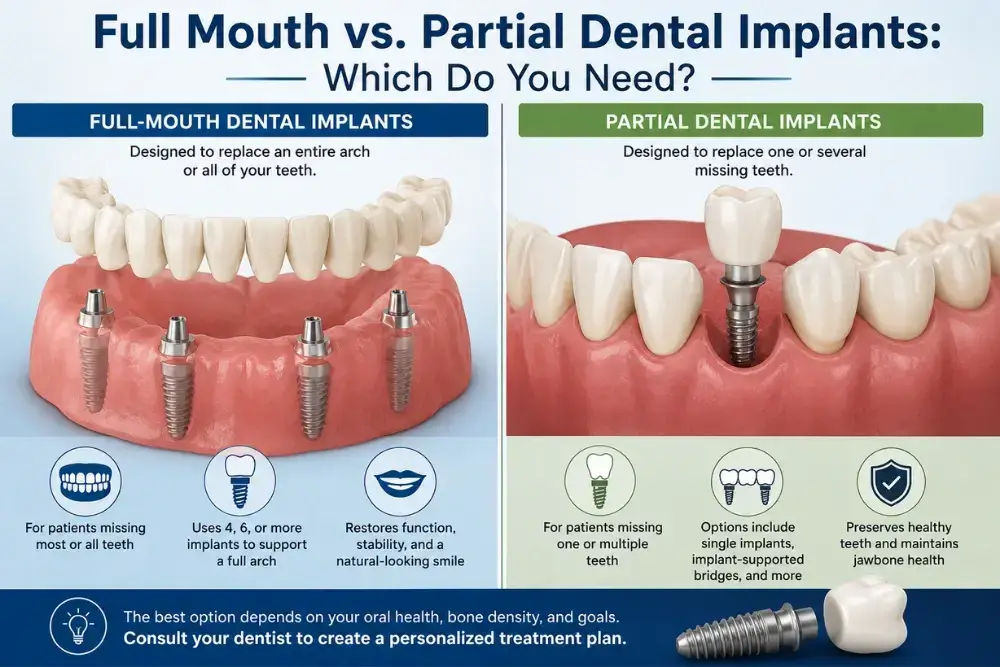
Types of Full-Mouth Dental Implants
When researching the types of full-mouth dental implants, you will commonly encounter full-arch approaches such as All-on-4 and All-on-6.
All-on-4 Dental Implants
All-on-4 treatment uses four strategically placed implants to support a full-arch restoration in appropriate patients.
The concept is different from replacing every missing tooth with an individual implant. Instead, the implants act as support for a complete arch of replacement teeth.
Whether All-on-4 is appropriate depends on your individual anatomy and treatment needs.
All-on-6 Dental Implants
All-on-6 uses six implants to support a full arch when appropriate.
Having additional implant support may benefit certain patients, but that does not mean All-on-6 is automatically better than All-on-4.
Your dentist needs to evaluate your bone, gums, bite, remaining teeth, and overall oral health before recommending a specific approach.
Other Full-Arch Implant Solutions
Full-arch treatment can involve different implant and restoration configurations depending on the patient’s needs.
This is why a consultation is important. The number of implants is only one part of the treatment plan. The condition of the jawbone, the design of the restoration, and your existing oral health all matter.
Essentials Dental provides both All-on-4 and All-on-6 full-arch implant options as part of its dental implant services.
What Are Partial Dental Implants?
Patients often use the term “partial dental implants” and sometimes phrase it as “dental partial implants” when they are missing some, but not all, of their teeth.
There is not necessarily one specific procedure called a “partial dental implant”.
Instead, your dentist may recommend different implant-based solutions depending on how many teeth are missing and where the gaps are located.
These can include:
- A single dental implant with a crown
- Multiple individual dental implants
- An implant-supported bridge
- Other implant-supported restorations
The important distinction is that you may be able to replace only the teeth you are missing rather than undergoing full-arch treatment.
Can You Get Partial Dental Implants?
Yes. If you are missing only some teeth, your dentist can often design implant treatment around those specific gaps.
For example, someone missing one tooth may be a candidate for a single-tooth implant.
Someone missing several adjacent teeth may be considered for an implant-supported bridge.
Someone who has lost most of the teeth in an arch may need a different approach, such as a full-arch restoration.
The right solution depends on your individual oral health and the condition of the remaining teeth.
Single-Tooth Dental Implants
If you have lost one tooth, your dentist may use a single dental implant to support a replacement crown.
The implant acts as an artificial tooth root. Once the implant has integrated with the jawbone and treatment has progressed appropriately, your dentist can attach a custom restoration to replace the visible tooth.
One advantage of this approach is that it focuses treatment on the missing tooth rather than replacing an entire section of your smile.
Essentials Dental offers single-tooth implant treatment as part of its implant services in Glendale Heights. If the tooth is still present but too damaged to save, a tooth extraction is usually the first step before implant placement.
Implant-Supported Bridges for Multiple Missing Teeth
What if you are missing several teeth next to each other? You may not need one implant for every missing tooth.
An implant-supported bridge can use dental implants to support a restoration that replaces multiple teeth.
This can be an option when several teeth are missing while other parts of your mouth remain healthy.
Essentials Dental specifically offers implant-supported bridges for patients who have lost several teeth.
Partials vs. Implants: What’s the Difference?
Patients sometimes compare traditional partial dentures with implant-based tooth replacement.
A traditional removable partial denture uses a removable appliance to replace missing teeth. Depending on the design, it may rely on remaining teeth and surrounding structures for support.
Dental implants, on the other hand, are surgically placed into the jawbone and can support crowns, bridges, or dentures.
| Traditional Partial | Implant-Based Replacement |
| Removable | Can provide fixed support |
| Replaces multiple missing teeth | Can replace one or multiple teeth |
| Does not require an implant for support | Uses implants as artificial tooth roots |
| Can be appropriate for certain patients | Requires sufficient conditions for implant treatment |
| Requires removal for cleaning | Requires implant-specific hygiene and maintenance |
Neither option is automatically right for everyone.
Your dentist should consider your oral health, anatomy, number of missing teeth, treatment goals, and preferences.
Full-Mouth Teeth Replacement Options
If you have lost most or all of your teeth, you may have several possible full-mouth teeth replacement options.
Depending on your situation, these may include:
Traditional Dentures
Traditional dentures replace missing teeth with a removable appliance.
They do not require surgical implant placement and may be appropriate for some patients.
Implant-Supported Dentures
Dental implants can provide support and stability for certain types of dentures.
This can be useful for patients who want an implant-supported alternative to a conventional removable denture.
All-on-4
All-on-4 uses strategically placed implants to support a complete arch restoration in appropriate cases.
All-on-6
All-on-6 uses six implants to support a complete arch when clinically appropriate.
Individual Implants and Implant Bridges
Patients who still have healthy teeth may not need a complete full-arch restoration. Individual implants or implant-supported bridges can replace specific missing teeth instead.
Essentials Dental’s implant services include single-tooth implants, implant-supported bridges, and full-arch All-on-4 and All-on-6 options.
How Do You Know Whether You Need Full-Mouth or Partial Implants?
The number of missing teeth is important, but it is not the only factor.
Your dentist may consider:
- How Many Teeth Are Missing? Someone missing one tooth generally needs a very different treatment plan from someone missing every tooth in an arch.
- Where Are the Missing Teeth? The location of the missing teeth affects chewing, appearance, bite, and the design of the replacement.
- What Condition Are Your Remaining Teeth In? If you still have several strong, healthy teeth, preserving them may allow for a more targeted treatment, sometimes with a root canal rather than extraction. If many remaining teeth are severely damaged or have a poor prognosis, your dentist may consider a full-arch approach.
- How Healthy Are Your Gums? Healthy gums and supporting tissues are important when planning dental implants. Your dentist may need to address existing periodontal problems before implant treatment.
- Do You Have Enough Bone? Dental implants require adequate bone support. Some patients who have experienced significant bone loss may need additional treatment, such as bone grafting or a sinus lift, before or as part of implant treatment.
Essentials Dental offers bone grafting and sinus lift procedures when needed to create appropriate support for implants.
- What Are Your Treatment Goals? Some patients primarily want to replace one missing tooth. Others want to restore an entire arch. Your goals help your dentist determine which treatment options are worth considering.
Are Full Dental Implants the Same as Normal Dental Implants?
Not exactly.
Patients often use “full dental implants” informally to describe treatment involving many missing teeth or an entire arch. A dental implant itself is the artificial tooth root placed into the jawbone.
The restoration supported by those implants could be:
- A crown
- A bridge
- A denture
- A full-arch restoration
So when you see terms such as full dental implants, full-mouth implants, or full-arch implants, it is important to understand what specific treatment is actually being described.
Do You Need Bone Grafting Before Dental Implants?
Not every patient needs bone grafting.
However, previous tooth loss can be associated with changes in the jawbone over time. If there is not enough bone to provide appropriate implant support, your dentist may discuss bone grafting or another preparatory procedure.
Essentials Dental offers bone grafting and sinus lift procedures for patients who need additional support for implant treatment.
A dental examination and appropriate imaging can help determine whether you are a candidate for implants and whether you need additional treatment.
Full Mouth or Partial Implants: Which One Is Right for You?
There is no universal answer.
Partial implant treatment may be appropriate when you have a limited number of missing teeth and healthy teeth remain.
Your dentist may consider full-arch treatment when most or all teeth in an arch are missing or cannot be predictably restored.
For example:
- Missing one tooth → a single-tooth implant may be considered.
- Missing several adjacent teeth → an implant-supported bridge may be considered.
- Missing most or all teeth in an arch → full-arch options such as All-on-4 or All-on-6 may be considered.
Your dentist can determine which options are appropriate after evaluating your teeth, gums, bone, bite, and overall oral health.
How Long Do Dental Implants Last?
Dental implants are designed as a long-term tooth replacement option, but they are not maintenance-free.
Good oral hygiene, regular dental examinations, and appropriate professional care are important for maintaining your implants and the tissues around them.
Essentials Dental emphasizes ongoing hygiene, follow-up visits, and maintenance as part of long-term implant care.
Your dentist can also give you specific instructions based on the type of implant restoration you receive.
Frequently Asked Questions
What are the types of full-mouth dental implants?
Common full-arch implant approaches include All-on-4 and All-on-6. The appropriate option depends on your anatomy, bone, remaining teeth, oral health, and treatment goals.
Can you get partial dental implants?
Yes. Patients who are missing only some teeth may be candidates for individual dental implants or implant-supported bridges, depending on their specific situation.
What are partial implants?
“Partial implants,” sometimes called dental partial implants, is generally an informal term for implant-based treatment that replaces some missing teeth rather than an entire arch. The actual treatment may involve individual implants or an implant-supported bridge.
Are dental implants better than partial dentures?
Not necessarily for every patient. Dental implants provide a different type of support and may offer a fixed solution in appropriate cases, while removable partial dentures may suit other patients.
How many implants are needed for a full mouth?
The number depends on the treatment approach and your individual anatomy. Full-arch treatments can use strategically positioned implants to support an entire arch rather than placing one implant for every missing tooth.
Are All-on-4 and All-on-6 the same?
No. Both are full-arch implant approaches, but they use different numbers of implants. Which option is appropriate depends on the individual patient’s clinical situation.
Do I need bone grafting for dental implants?
Not necessarily. Some patients have sufficient bone for implant placement, while others may need bone grafting or a sinus lift before receiving implants.
Can I replace only two or three missing teeth with implants?
In many cases, patients with a limited number of missing teeth can receive targeted implant treatment rather than full-arch treatment. Your dentist will evaluate the location and condition of the missing teeth and surrounding structures.
Restore Your Smile With a Personalized Implant Plan
Losing teeth does not mean you automatically need a full-mouth reconstruction.
Some patients may benefit from a single implant. Others may need an implant-supported bridge, while patients with extensive tooth loss may be candidates for a full-arch solution such as All-on-4 or All-on-6.
The important step is getting a professional evaluation so you can understand which options are appropriate for your smile.
At Essentials Dental in Glendale Heights, the dental team provides personalized implant treatment ranging from individual tooth replacement to full-arch restoration. The practice uses digital imaging and guided treatment planning to evaluate patients and develop individualized solutions.
If you are missing one tooth, several teeth, or most of your smile, schedule a dental implant consultation with Essentials Dental to discuss your options.


