

When a tooth is badly damaged or infected, your dentist may give you two options: a root canal or an extraction. That can leave you wondering which treatment is actually better.
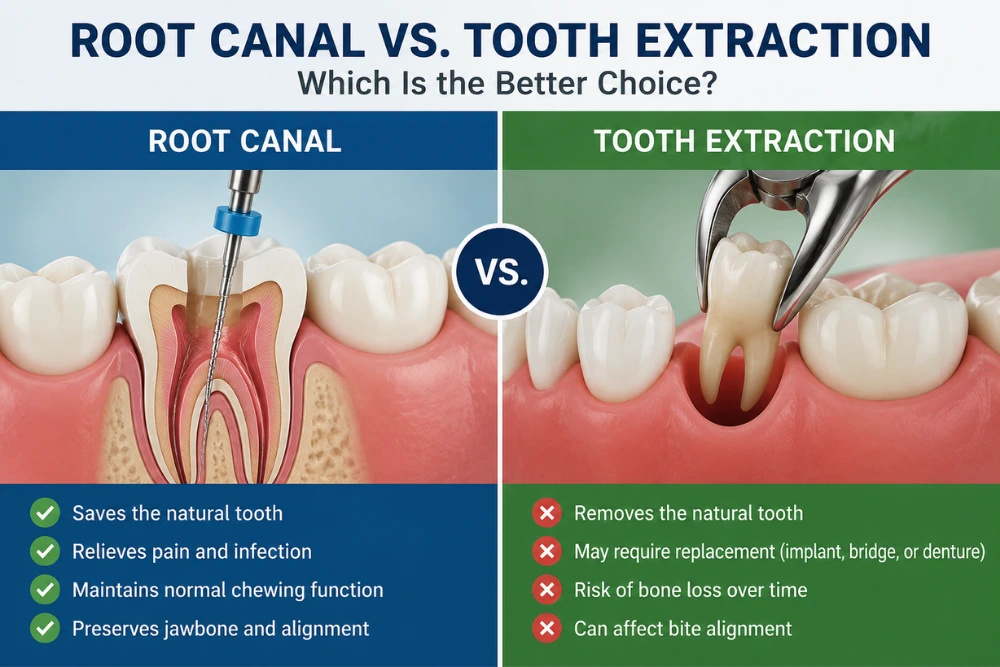
In most cases, dentists prefer a root canal when the tooth can still be restored. Root canal treatment removes the infected or damaged pulp inside the tooth while allowing you to keep the natural tooth in place. Extraction removes the tooth completely and may require another treatment, such as a dental implant or bridge, to replace it later.
However, there is no single answer for every patient. The right choice depends on how much healthy tooth structure remains, whether the tooth is cracked, the condition of the surrounding tissues, and whether the tooth can be restored successfully.
Here is what you should know about root canal vs. extraction before making a decision.
Root Canal vs. Extraction: What’s the Difference?
A root canal and an extraction solve different problems.
A root canal is designed to save a damaged or infected tooth. During treatment, the dentist removes the affected pulp from inside the tooth. The dentist then cleans and disinfects the root canals, fills and seals them, and restores the tooth.
An extraction removes the entire tooth from its socket. Your dentist may recommend it when the tooth is too damaged to restore or when keeping it would not provide a predictable long-term result.
| Root Canal | Tooth Extraction |
| Preserves the natural tooth | Removes the natural tooth |
| Removes infected pulp | Removes the entire tooth |
| Maintains the existing tooth structure | Leaves a space where the tooth was |
| May require a crown afterward | May require an implant, bridge, or denture |
| Designed to restore the tooth’s function | Requires healing and possible tooth replacement |
The goal is not simply to choose the procedure that sounds easier. The goal is to determine which treatment provides the healthiest and most predictable outcome for your particular tooth.
What Is a Root Canal?
A root canal treats problems affecting the pulp, the soft tissue inside a tooth that contains nerves and blood vessels.
Deep decay, repeated dental procedures, trauma, or cracks can allow bacteria to reach the pulp. Once the pulp becomes severely inflamed or infected, it may not heal on its own.
During root canal treatment, the dentist removes the damaged or infected tissue, cleans the inside of the tooth, and seals the root canals. The dentist can then restore the tooth, so it continues functioning normally.
Essentials Dental provides root canal therapy in Glendale Heights with an emphasis on precise diagnosis, patient comfort, and preserving natural teeth when possible.
When Is a Root Canal the Better Choice?
A root canal may be the better option when the tooth is infected or damaged but still structurally capable of being restored.
Your dentist may recommend root canal treatment when:
- The pulp is infected or severely inflamed
- Deep decay has reached the inside of the tooth
- The tooth has experienced trauma
- A crack has affected the pulp, but the tooth remains restorable
- There is enough healthy tooth structure to support a restoration
- The surrounding bone and tissues can support the tooth
Saving your natural tooth can help preserve your existing bite and chewing function without immediately requiring a replacement tooth.
That does not mean every infected tooth should automatically receive a root canal. Your dentist needs to evaluate the tooth before determining whether it can be predictably saved.
When Is Tooth Extraction the Better Choice?
Sometimes a tooth has simply sustained too much damage to make saving it realistic.
Your dentist may recommend extraction when:
- The tooth is severely broken down
- There is not enough healthy structure to restore it
- A fracture extends through the root in a way that prevents predictable treatment
- Extensive decay has destroyed the tooth
- The tooth has a poor long-term prognosis
- Previous treatment has failed, and the tooth cannot be predictably retreated
In these situations, removing the tooth may be the safest option for protecting your overall oral health.
An extraction is not necessarily a bad outcome. If a tooth cannot be saved, removing it can eliminate a source of infection or pain. The next question then becomes how to replace the missing tooth when appropriate.
Root Canal or Pull Tooth Out: Which Is Better?
If your tooth can be predictably restored, dentists generally prefer preserving the natural tooth.
Your natural tooth is already designed to fit your bite and function with the surrounding teeth. A successful root canal allows you to keep that tooth rather than creating a gap that may eventually need replacement.
However, if the tooth cannot be restored, trying to save it at all costs may not be the best choice.
Think of the decision this way:
- Restorable tooth → a root canal may allow you to keep it.
- Non-restorable tooth → extraction may be necessary.
You should base the decision on the condition and prognosis of the tooth rather than simply choosing the treatment that seems less intimidating.
What About a Cracked Tooth and Root Canal Treatment?
A cracked tooth does not automatically mean you need an extraction.
Dentists can treat some cracked teeth with a root canal if the damage has affected the pulp, but the tooth still has enough healthy structure to be restored.
Other cracks are much more serious.
For example, a fracture that extends deeply into the root may make the tooth impossible to save predictably. In those cases, your dentist may recommend extraction.
This is why searching for “cracked tooth root canal” and trying to determine your treatment from symptoms alone can be misleading. The location and severity of the crack matter.
A dentist may need to examine the tooth, evaluate your symptoms, and take dental X-rays or other appropriate images before determining whether the tooth can be saved.
Root Canal vs. Extraction for a Back Molar
The decision can be particularly important when the affected tooth is a back molar.
Molars play a major role in chewing and often have multiple roots and canals, which can make treatment more complex. At the same time, losing a molar can leave an important gap in the back of your mouth.
If the molar can be predictably restored, a root canal may allow you to preserve it.
If the molar is severely damaged or cannot be restored, extraction may be the appropriate treatment. Your dentist can then discuss whether you should eventually replace the missing tooth.
Essentials Dental notes that root canal treatment time depends on the tooth and its complexity. Molars sometimes require more treatment time or additional visits.
Is a Root Canal More Painful Than an Extraction?
This is one of the most common concerns patients have when comparing a root canal or extraction.
Dentists perform modern root canal treatment using local anesthesia to numb the area. During treatment, you should not expect to feel the sharp pain associated with an untreated dental infection.
Some soreness or sensitivity can occur after treatment, but this is generally temporary.
The same is true of extraction: your dentist will anesthetize the tooth and surrounding area during the procedure, but the extraction site needs time to heal afterward.
The experience varies from patient to patient, which is why it is better to discuss your specific situation with your dentist rather than assuming one procedure will automatically be more painful. Essentials Dental also provides a dedicated guide comparing the discomfort associated with root canals and extractions.
What Happens If You Choose Extraction?
Removing a tooth solves the immediate problem of taking out a tooth that cannot be saved. But the treatment may not end there.
Depending on the location of the tooth and your overall oral health, your dentist may recommend replacing it with:
- A dental implant
- An implant-supported bridge
- A traditional bridge
- A partial denture
Replacing a missing tooth can help restore chewing function and prevent the gap from becoming a long-term concern.
Essentials Dental offers dental implants for patients who have lost individual or multiple teeth, including single-tooth implants, implant-supported bridges, and full-arch options.
Root Canal vs. Extraction: What About Cost?
It is tempting to compare only the initial price of a root canal with the initial price of an extraction.
That does not always give you the full picture.
A crown or another restoration may follow a root canal. Tooth replacement may eventually follow an extraction, depending on your needs.
For example, the long-term treatment plan after extraction could look like this: extraction, then healing, then implant placement, then restoration.
Saving the tooth, by contrast, may involve just a root canal followed by a restoration or crown.
The total cost depends on your tooth, the required restoration, your oral health, and the treatment your dentist recommends.
Your dentist can explain the complete treatment plan and associated costs before you proceed.
How Does a Dentist Decide Between a Root Canal and Extraction?
Your dentist does not have to guess.
The decision may involve:
- Examining the tooth to determine the extent of damage
- Reviewing your symptoms and how long you have experienced them
- Taking dental X-rays or other imaging when appropriate
- Evaluating the remaining tooth structure
- Checking for cracks or fractures
- Assessing the surrounding bone and gums
- Determining whether the tooth can be predictably restored
Symptoms can suggest that something is wrong, but they cannot determine by themselves whether you need a root canal or extraction. Essentials Dental similarly recommends professional examination and appropriate imaging rather than self-diagnosis.
So, Should You Get a Root Canal or Pull the Tooth?
If your dentist can predictably restore the tooth, a root canal can often treat the infection while preserving your natural tooth.
If the tooth is too damaged, severely fractured, or otherwise cannot be restored, extraction may be the more appropriate option.
The best decision is not about choosing the procedure you have heard is easier. It is about choosing the treatment that gives your tooth and your overall oral health the best realistic outcome.
If you are experiencing persistent tooth pain, lingering sensitivity, pain when chewing, swelling, or other concerning symptoms, schedule an examination rather than waiting for the problem to disappear. Dental infections can progress without treatment.
Frequently Asked Questions
Is a root canal better than an extraction?
When your dentist can predictably restore a tooth, root canal treatment that preserves the natural tooth is generally preferred. If the tooth cannot be restored, extraction may be necessary. This is the core trade-off in deciding between root canal or extraction for any damaged tooth.
Can a cracked tooth get a root canal?
Sometimes. A cracked tooth may be treated with a root canal if the crack has affected the pulp, but the tooth remains structurally restorable. Severe fractures may require extraction.
Is a root canal better for a back molar?
If your dentist can predictably restore the molar, preserving it with root canal treatment may help maintain chewing function. The condition of the individual tooth determines whether treatment is appropriate.
What happens if I choose extraction instead of a root canal?
Your dentist will remove the tooth, and the area will need time to heal. Depending on your situation, your dentist may recommend replacing the missing tooth with an implant, bridge, or partial denture.
Can every infected tooth be saved with a root canal?
No. Root canal treatment cannot predictably save every tooth. Severe structural damage, certain fractures, or insufficient remaining tooth structure may make extraction the better option.
Should I wait if my tooth stops hurting?
No. A decrease in pain does not necessarily mean the underlying problem has resolved. If you have symptoms suggesting infection or pulp damage, a dental examination is the safest way to determine what is happening.
Get Your Tooth Evaluated at Essentials Dental
If you have been told that you need either a root canal or extraction, you do not have to make the decision based on fear or guesswork.
Essentials Dental can examine the tooth, explain what is happening, and help you understand whether saving the tooth is realistic or whether you should consider extraction and replacement.
Essentials Dental is located at 2161 Bloomingdale Rd. in Glendale Heights, IL, and serves patients in Glendale Heights, Bloomingdale, Lombard, and surrounding communities.
If you are dealing with persistent tooth pain, swelling, a cracked tooth, or another dental concern, schedule an examination to find out which treatment is right for you.


