

Veneers vs crowns come down to one thing: coverage. A veneer is a thin shell that covers only the front of a tooth, mainly for looks. A crown caps the entire tooth to restore a damaged or weak one. Choose a veneer for a mostly healthy tooth you want to improve cosmetically, and a crown when a tooth needs real structural protection. A dentist confirms which fits your situation.
You want to fix a tooth, and you keep running into the same two words. Veneers and crowns. They sound interchangeable, but they solve different problems, and picking the wrong one wastes money and time. So let me break down veneers vs crowns in plain terms, how they differ, what each costs you in tooth structure, and which one is right for your situation.
Veneers vs Crowns: The Core Difference
Start with the one distinction that explains everything else. It is about how much of the tooth gets covered.
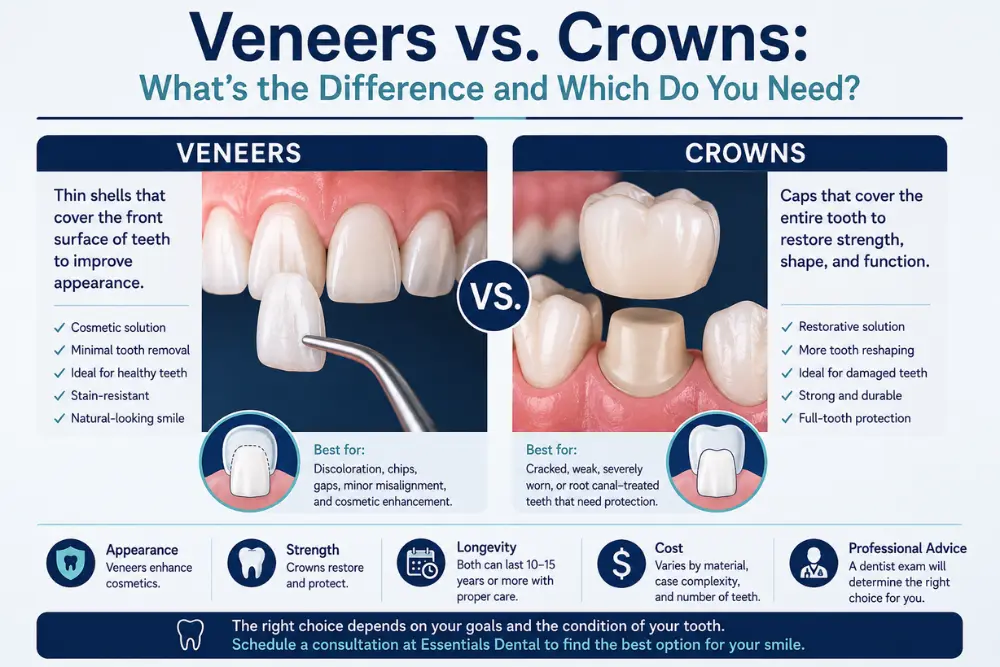
A veneer is a thin shell, usually porcelain or composite, bonded to the front surface of a tooth. It changes the look of the tooth while leaving most of the natural structure intact. A crown, sometimes called a cap, covers the entire tooth on all sides. That full coverage is why the veneer vs crown decision really comes down to cosmetics versus structure. A veneer makes a tooth look better. A crown holds a compromised tooth together.
Dental Caps Versus Veneers: How Much Tooth Is Involved
Here is where dental caps versus veneers really separate. The amount of tooth your dentist removes to place each one is very different, and it matters more than most people realise.
For a veneer, the dentist removes only a thin layer from the front of the tooth, just enough for the shell to sit flush. It is a conservative, mostly cosmetic change. For a crown, more of the tooth is reshaped on every side so the cap can fit over it. That makes a crown more involved but also far stronger, which is exactly what a cracked, heavily filled, or root-canaled tooth needs. Neither is better in a vacuum. They are built for different jobs.
Composite Veneers vs Porcelain Crowns: Materials
Materials matter too, and this is where composite veneers vs porcelain crowns often come up. Veneers are typically made of porcelain or composite resin. Porcelain veneers look the most natural and last the longest, while composite veneers cost less and can be done faster, though they do not last as long.
Crowns can be made of porcelain, ceramic, metal, or porcelain fused to metal. A porcelain or ceramic crown gives the most natural look for a front tooth, while metal-based crowns offer maximum strength for back teeth that take heavy chewing force. Your dentist matches the material to the tooth, balancing appearance where it shows and strength where it works hardest.
Veneers vs Crowns on Front Teeth
For the smile zone, this is the question that matters most. Veneers vs crowns on front teeth usually favour veneers because front teeth are about appearance and do not take the heavy grinding force that molars do. A veneer gives a beautiful, natural result while preserving more of the healthy tooth.
But not always. If a front tooth is badly damaged, heavily filled, cracked, or has had a root canal, a crown is the safer choice, because that tooth needs full coverage to stay strong. So the rule of thumb is simple. A healthy front tooth you want to beautify leans toward veneers. A weak or damaged front tooth leans toward a crown. The tooth’s condition decides, not just its position.
Crowns vs Veneers: Cost and Durability
People often frame crowns vs veneers around price and longevity, so here is the honest picture. Veneers and crowns are both long-term investments, and both can last well over a decade with good care. Porcelain veneers commonly last ten to fifteen years or more. Crowns often last as long or longer, since they are built to withstand full chewing force.
Cost varies by material, by how many teeth are involved, and by your specific case, so the only accurate number comes from an exam. What matters more than a price tag is choosing the right tool for the tooth, because the wrong choice, however cheap, ends up costing more.
Which One Do You Actually Need?
Here is the quick way to think about it. If your tooth is basically healthy and you want to improve its shape, color, or spacing, a veneer is usually the answer. If your tooth is cracked, weak, heavily filled, worn down, or has had a root canal, a crown is usually the answer, because it needs protection. When a veneer crown decision is genuinely close, it comes down to how much healthy tooth is left, and that is exactly the call a dentist makes with an exam and an X-ray. With veneers vs. crowns, there is no one-size answer, only the right fit for your tooth.
Get a Clear Answer at Essentials Dental
The fastest way to know whether you need a veneer or a crown is to have the tooth looked at. A quick exam settles it, and you leave knowing your real options and what they cost.
At Essentials Dental, we provide both veneers and crowns as part of our cosmetic and restorative care, and we will tell you honestly which one your tooth actually needs. Book an appointment or call 630-893-1300.
Cosmetic and Restorative Care, for Over 35 Years
Choosing between a veneer and a crown is a decision worth making with an experienced team, because the right call protects both your smile and your tooth.
35 Years of Getting the Choice Right
Essentials Dental has served Glendale Heights and Lombard as a private practice for over 35 years. That depth of experience means we have placed countless veneers and crowns, and we know exactly when each one is the right answer rather than defaulting to one or the other.
Both Options, Honest Advice
Because we do both cosmetic and restorative dentistry under one roof, our recommendation is guided by what your tooth needs, not by a single service. Sometimes that is a veneer. Sometimes it is a crown. We tell you which and why.
Artistry, Training, and a Conservative Touch
Our dentists, Dr. Son and Dr. Mach, bring postdoctoral advanced training and a conservative, patient-first philosophy to every case. We protect as many healthy teeth as we can, and we design results that look natural and last.
FAQs
What is the difference between veneers and crowns?
A veneer is a thin shell that covers only the front of a tooth for cosmetic reasons. A crown covers the entire tooth to restore and protect a damaged or weak one.
Which is better, a veneer or a crown?
Neither is universally better. A veneer suits a mostly healthy tooth you want to improve cosmetically. A crown suits a tooth that needs structural protection. The tooth’s condition decides.
Are veneers or crowns better for front teeth?
Front teeth often favour veneers, since they are about appearance and take less force. But a badly damaged or root-canaled front tooth usually needs a crown for full protection.
Do veneers or crowns remove more tooth?
Crowns remove more. A veneer needs only a thin layer off the front of the tooth, while a crown requires reshaping the tooth on all sides so the cap can fit over it.
How long do veneers and crowns last?
Both can last well over a decade with good care. Porcelain veneers commonly last ten to fifteen years or more, and crowns often last as long or longer.


